


BBC Audience Services
Streamlining the complaints team's efficiency to respond to social media posts with Generative AI (GenAI)
TL;DR
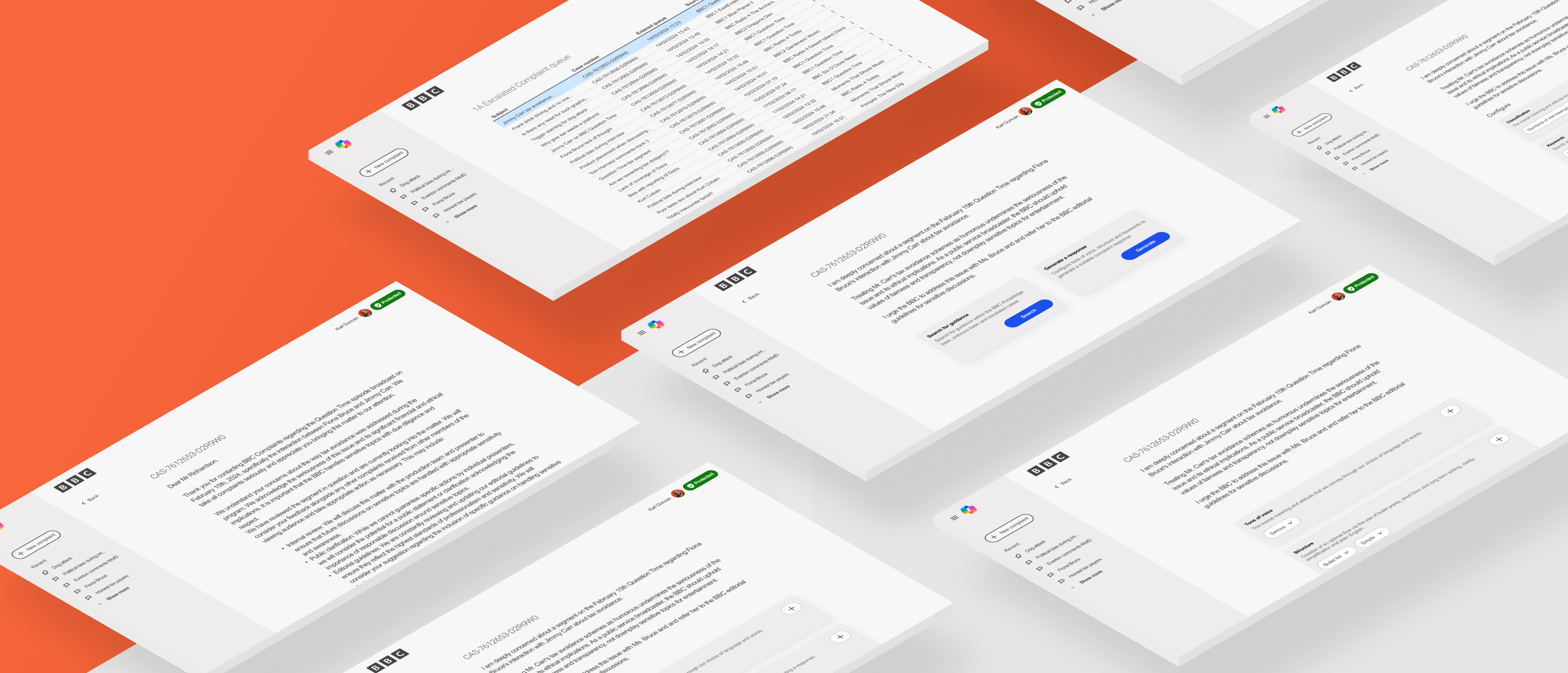
As part of Capita’s contract with BBC Audience Services, I worked within a one-month discovery team exploring how Generative AI could improve efficiency ahead of the 2026 renewal. I conducted SME interviews, mapped processes, and evaluated four service areas, narrowing scope to the Complaints Department. High complaint volumes, complex geopolitical issues, and inefficient knowledge management made it the prime candidate. I designed “as-is” and “to-be” journeys, created low- and high-fidelity flows, and proposed GenAI-assisted Knowledge Base search and drafting. The work demonstrated clear productivity gains, secured stakeholder alignment, and earned peer recognition for delighting the client.
Problem statement
BBC Audience Services, is currently managed by Capita under a contract that is due for renewal in 2026. In order to demonstrate to the BBC a more innovative approach a discovery team was assembled to explore the potential of Generative AI (GenAI) within a one-month discovery phase to enhance BBC Audience Services, preparing for the contract renewal negotiations.
BBC Audience Services: Understanding the context
I conducted four initial meetings with Subject Matter Experts (SMEs) representing each department within BBC Audience Services: Complaints, Customer Services, Technical Services, and Direct Services (Ticket applications). Due to time limitations and SME availability, obtaining a comprehensive understanding of their daily tasks, challenges, and potential improvement areas proved particularly demanding. Following the interviews, I collaborated with the teams' User Researchers (UR) to develop process maps and synthesis the collected data. To identify the service most suited for further investigation, I created a comparison matrix that assessed the four services across various characteristics using a three-point scale (1: least favourable, 3: most favourable).
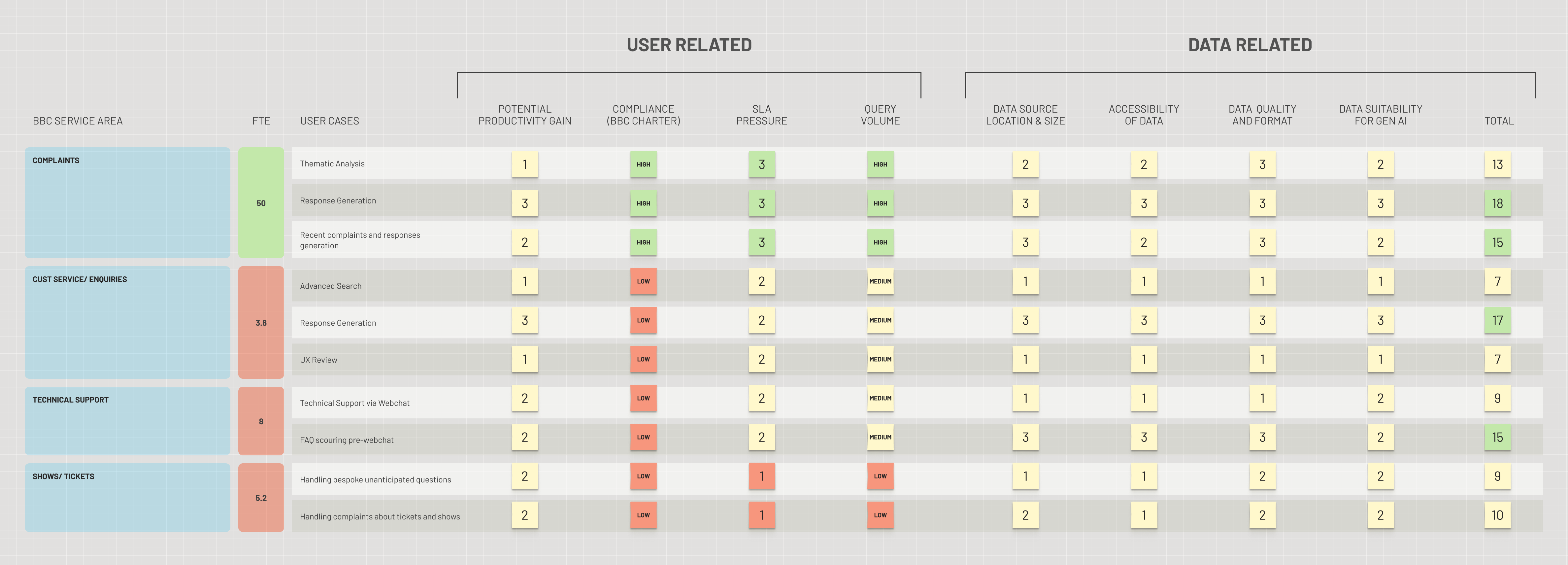
BBC GenAI - Audience Services overview solution matrix
Complaints department: Narrowing the scope
Following a collaborative assessment, the team identified the Complaints Department as the most suitable unit for the development of GenAI assistance. This selection was informed by several key factors. Firstly, the department boasts a considerably larger team compared to others. Secondly, they handle a significantly higher volume of complaints on a weekly basis, averaging 50,000 in Q4 2023. Thirdly, the nature of complaints dealt with is often complex, involving fluid geopolitical situations such as the conflicts in Ukraine and Israel-Gaza. Finally, complaints operators require the ability to swiftly search BBC material for context and respond to trending complaints fuelled by social media. These latter issues are often unpredictable and lack established guidance within the BBC Complaints Knowledge Base (KB).
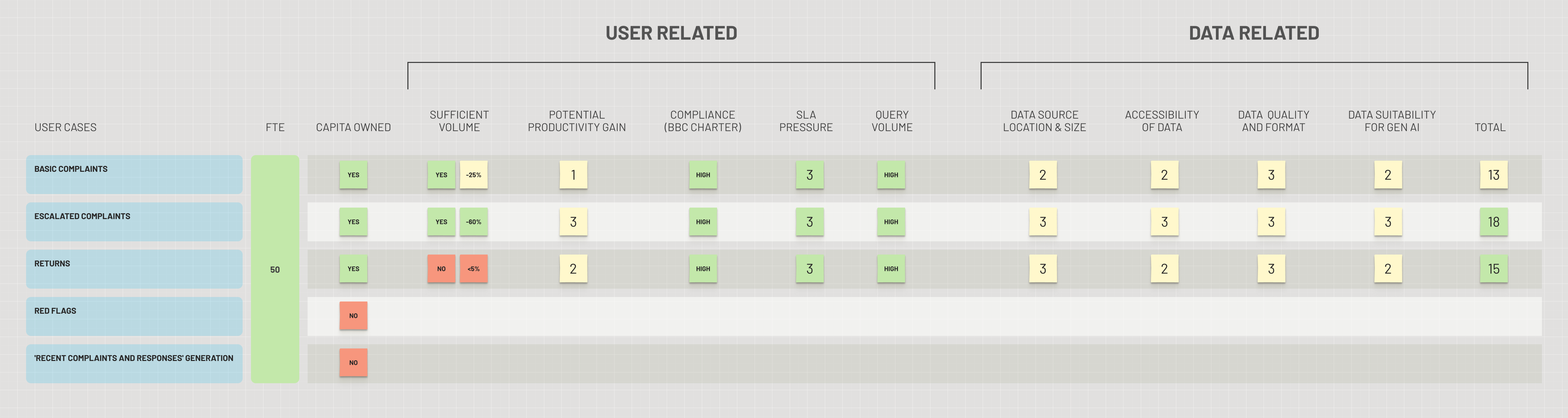
BBC GenAI - Complaints department overview solution matrix
User research interviews and persona development: Understanding users
Working alongside a UR, we interviewed and shadowed staff from the following roles within the Complaints team; Audience Services Specialist (basic complaints), Complaints Specialist (escalated complaints) and the Complaints Executive (Team leader role). Post interview we synthesised the data collected and speaking with the Complaint’s Manager (SME) we were directed to focus our attention on the Complaint’s Specialist role and user journey. Based on the data from our interviews with staff members I produced a persona for the Complaints Specialist role. This persona was then presented to key stakeholders and validated.
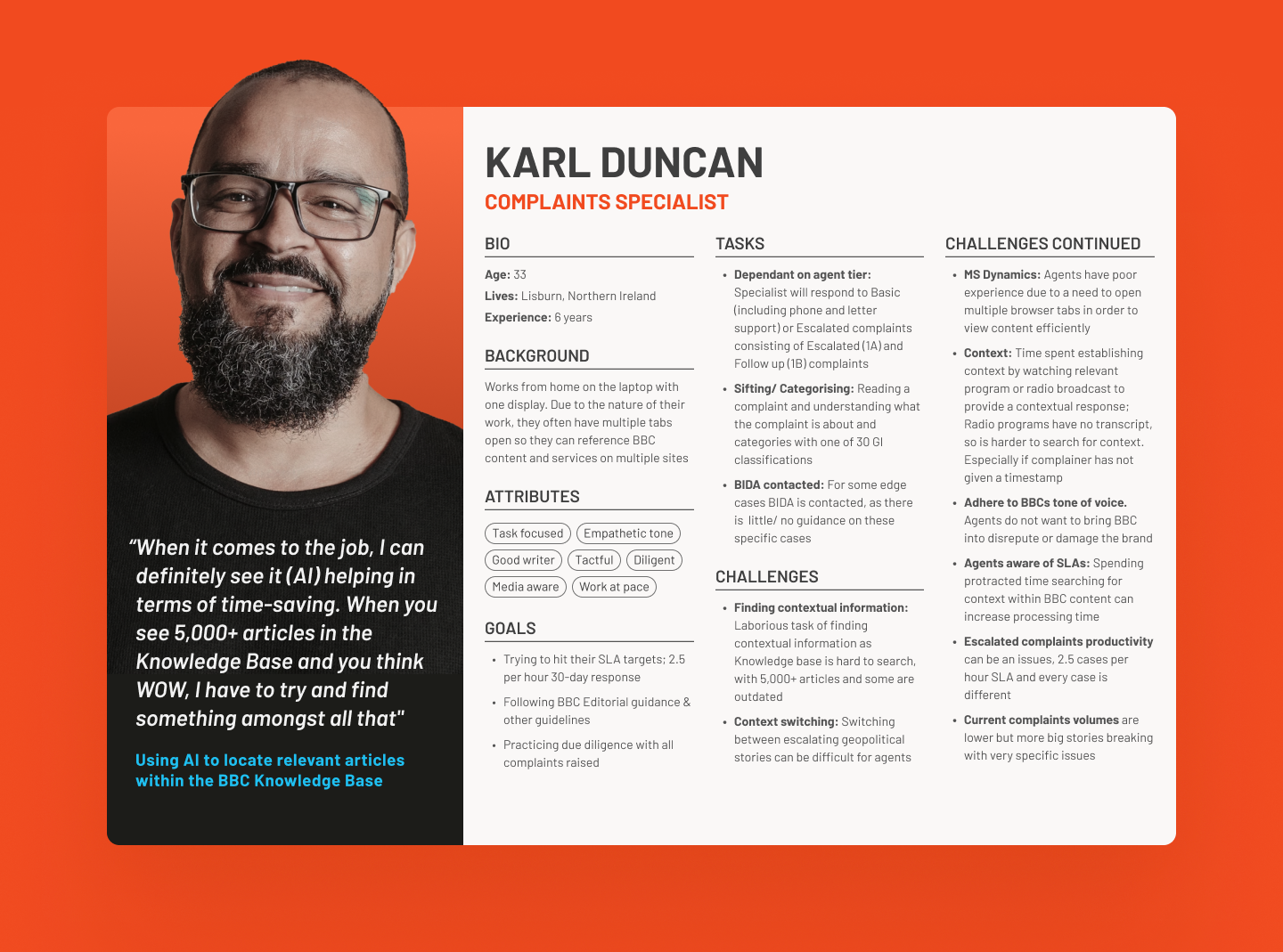
Understanding Complaint Specialist’ frustrations
Complaint Specialist frustrations
Through a combined analysis of data from the Complaints Manager (SME) and interviews with Complaints Specialists, I was able to map their current "as-is" user journey and identified several recurring frustrations/ pain points within the existing complaint handling process. In addition I created a Complaints Specialist persona which captured the key attributes, goals, tasks, and challenges faced within the role.
The Complaints Specialist is frustrated having to spend up to two thirds of their time searching for content within BBC Archives, BBC iPlayer, BBC Sounds and the BBC News and Sport websites and thereafter finding context within that found content to answer the complaint
The Complaints Specialist is frustrated with the current inefficient Knowledge Base (KB). The KB contains around 5,000 guidance articles (created by BBC directly) without summaries. This KB is difficult to navigate and populated with outdated articles. Complaints Specialist often resort to referencing previously resolved cases as a source of validated guidance
The Complaints Specialist is frustrated when drafting an appropriate response; trying to achieve the correct tone of voice to the complaint and the tone in which the complaint was written.
Mapping out the As-Is journey of a complex complaint
Scenario: End to end process of a Complex Complaints 1A; Entering the system and being sifted/ categorised by an Audience Service Specialist thereafter being processed by a Complaints Specialist (with potential for external guidance from BBC BIDA).
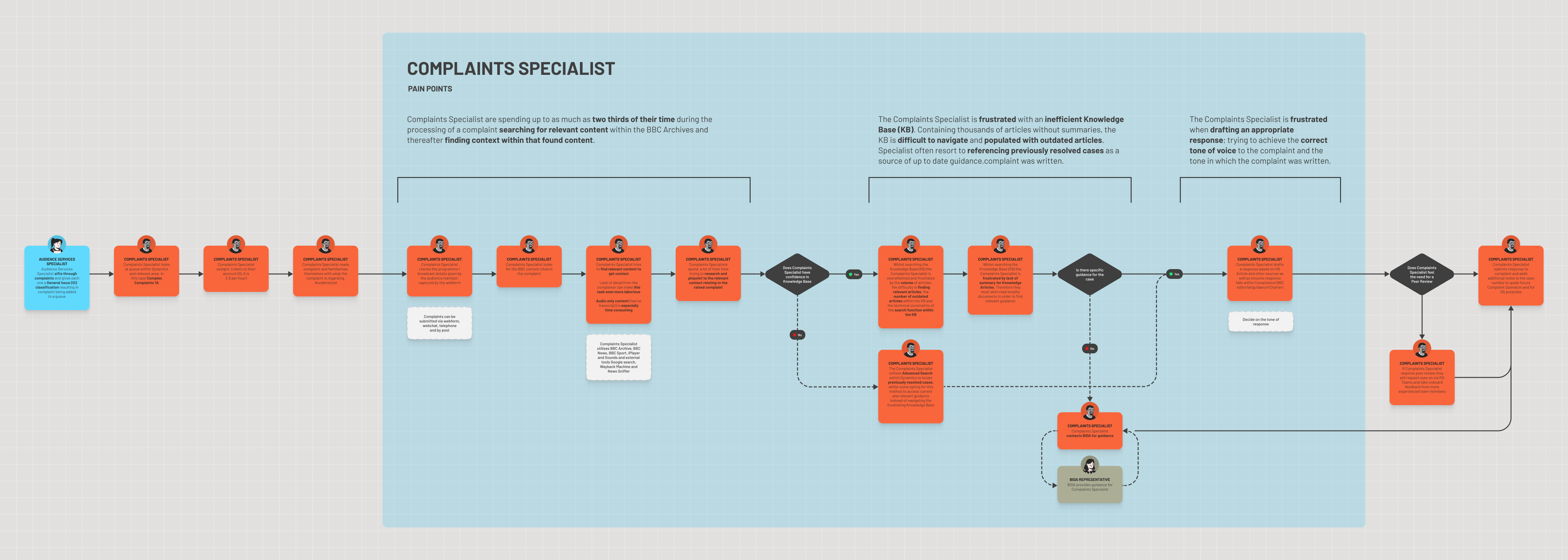
BBC GenAI - Complex Complaints as is process map
Generating solution for complex complaints
Having identified user frustrations, I brainstormed solutions with other members of the team, prioritising those offering productivity gains to the complaints department, compliance within BBC guidance, and data that both lent itself to improvement by GenAI and was of satisfactory quality. While some solutions were deferred due to feasibility concerns, we proposed leveraging Retrieval-Augmented Generation (RAG) for Knowledge Base search and response drafting assistance.
Designing the To-Be Journey, a solution for complex complaints
Working alongside the BA/PO to create user stories, I then mapped out the "to-be" journey. This artefact visualised how GenAI-assisted KB search and response drafting would integrate with the existing Complaint Specialist workflow. I then presented this optimised "to-be" journey to stakeholders, gaining their approval.
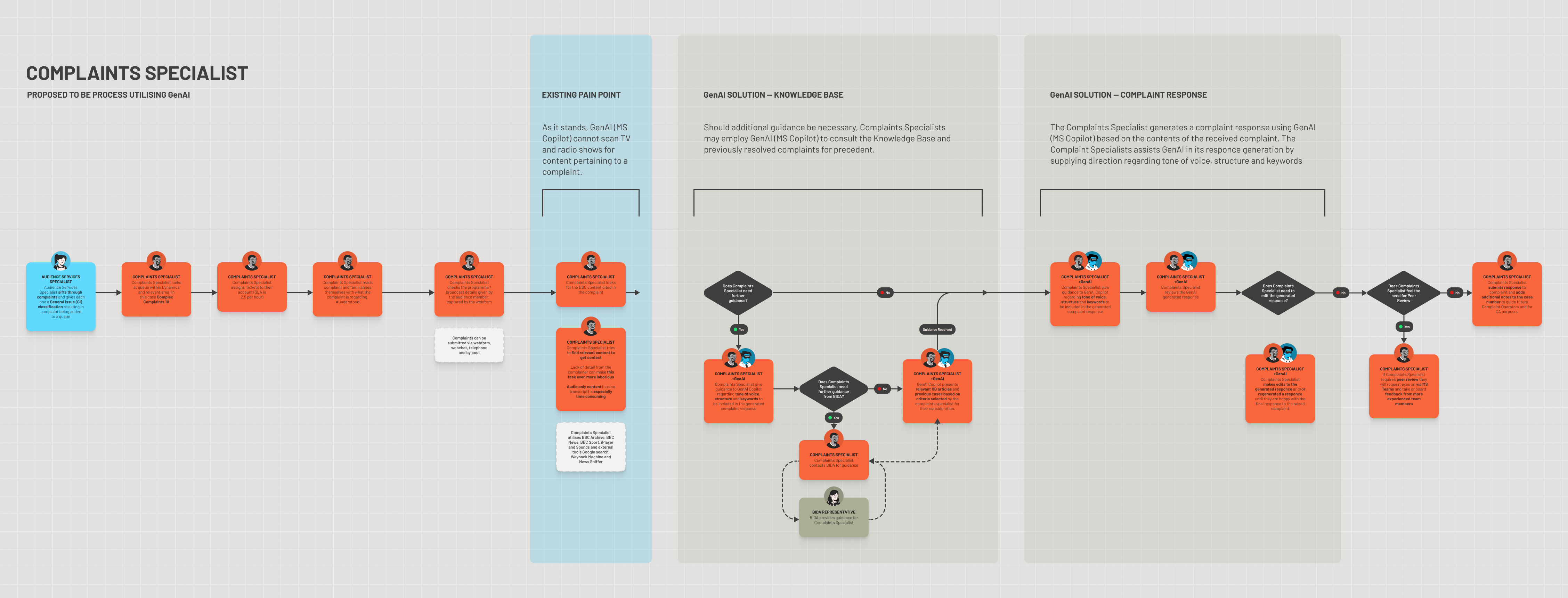
BBC GenAI - Complex Complaints to be process map
Visualising basic user Task flows (low-fidelity)
Based on the "to-be" journey, I created basic user task flows (low-fidelity) to quickly explore and validate the user experience. These simple flows outlined the specific steps and interactions required for Complaint Specialists to use the new GenAI features. This approach allowed us to identify potential usability issues early, ensuring a smooth and intuitive workflow before investing time in detailed, high-fidelity designs.
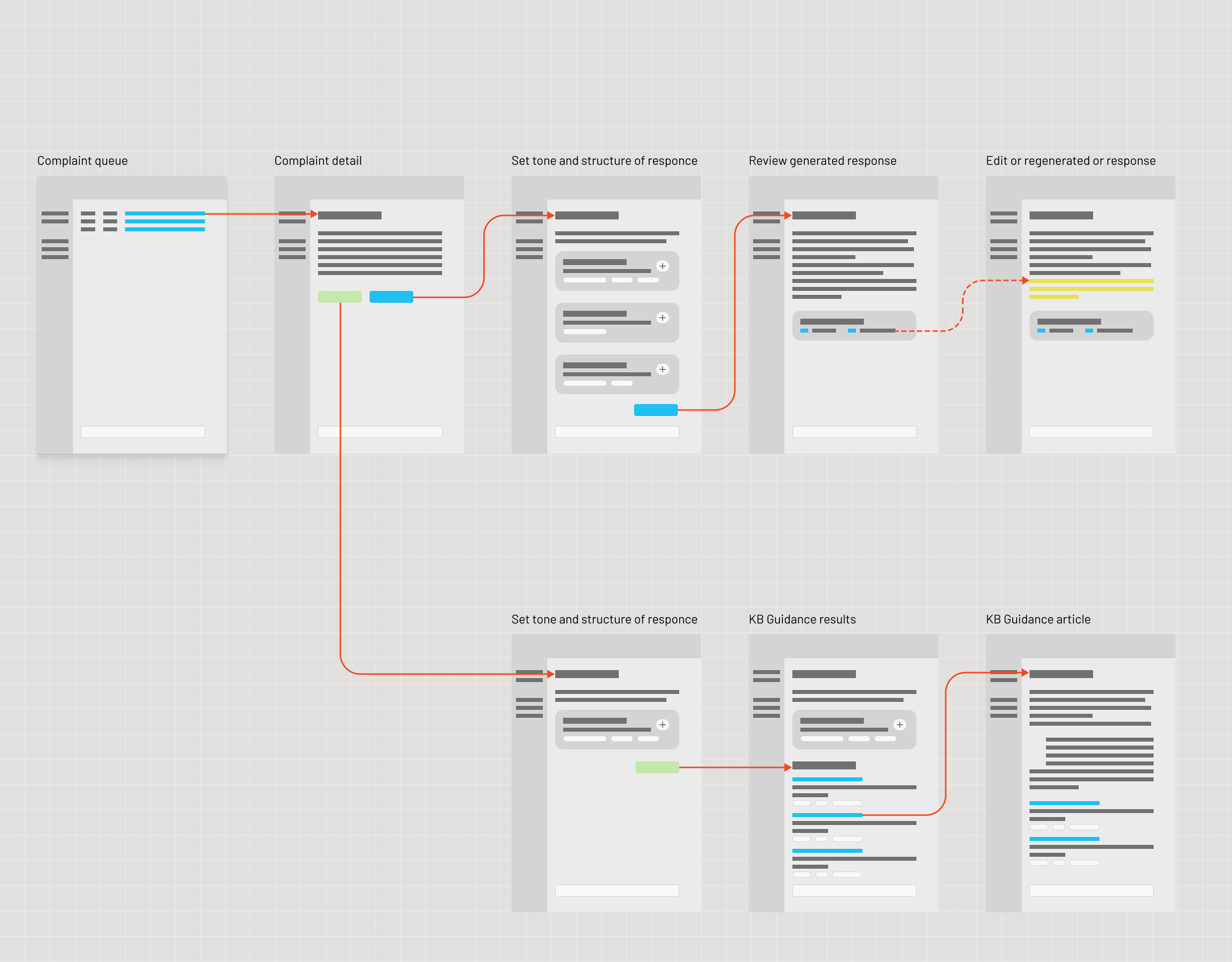
Low fidelity task flows - Complex complaint responce and guidance generation via GenAI
High-fidelity screen concepts
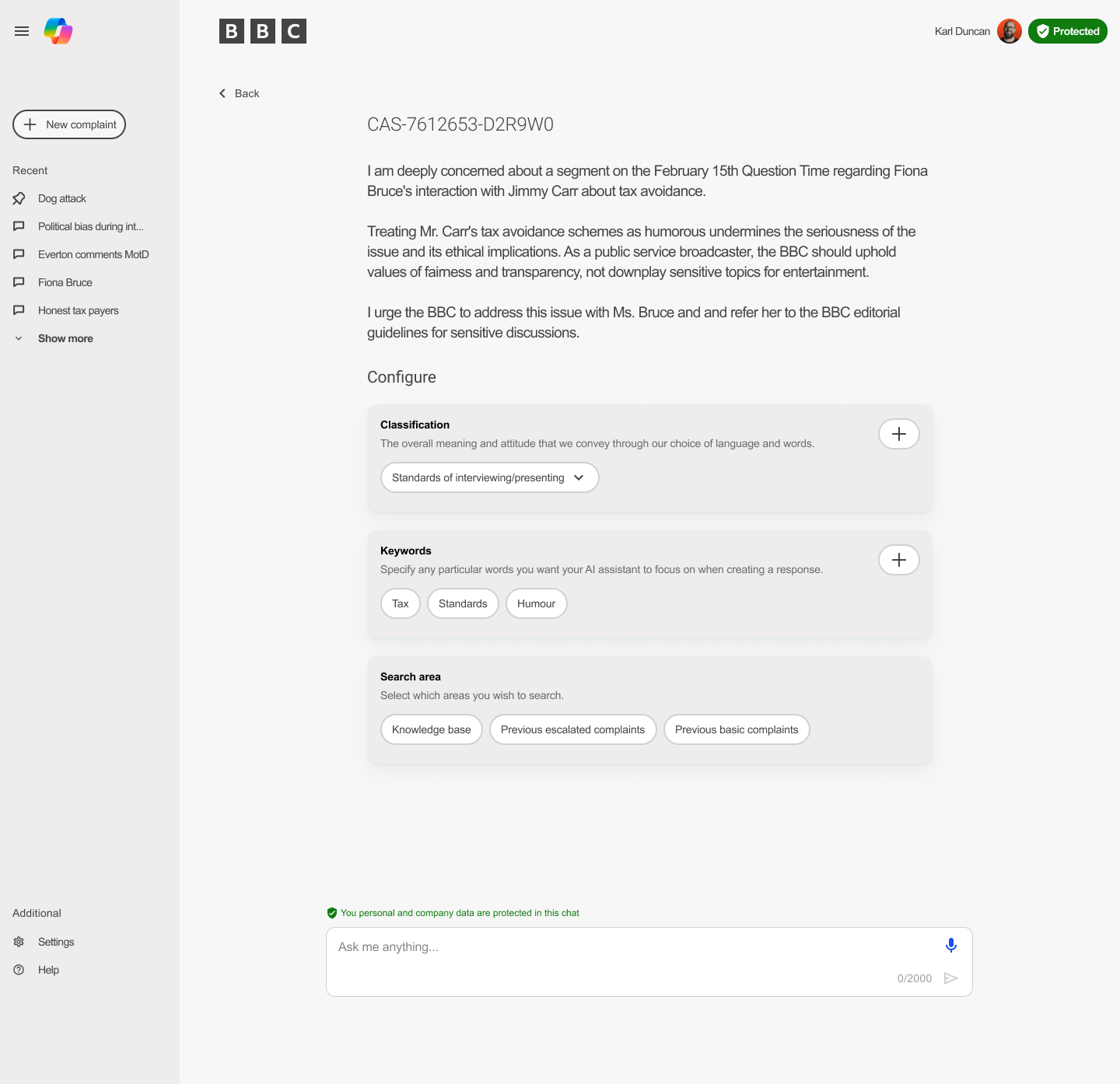
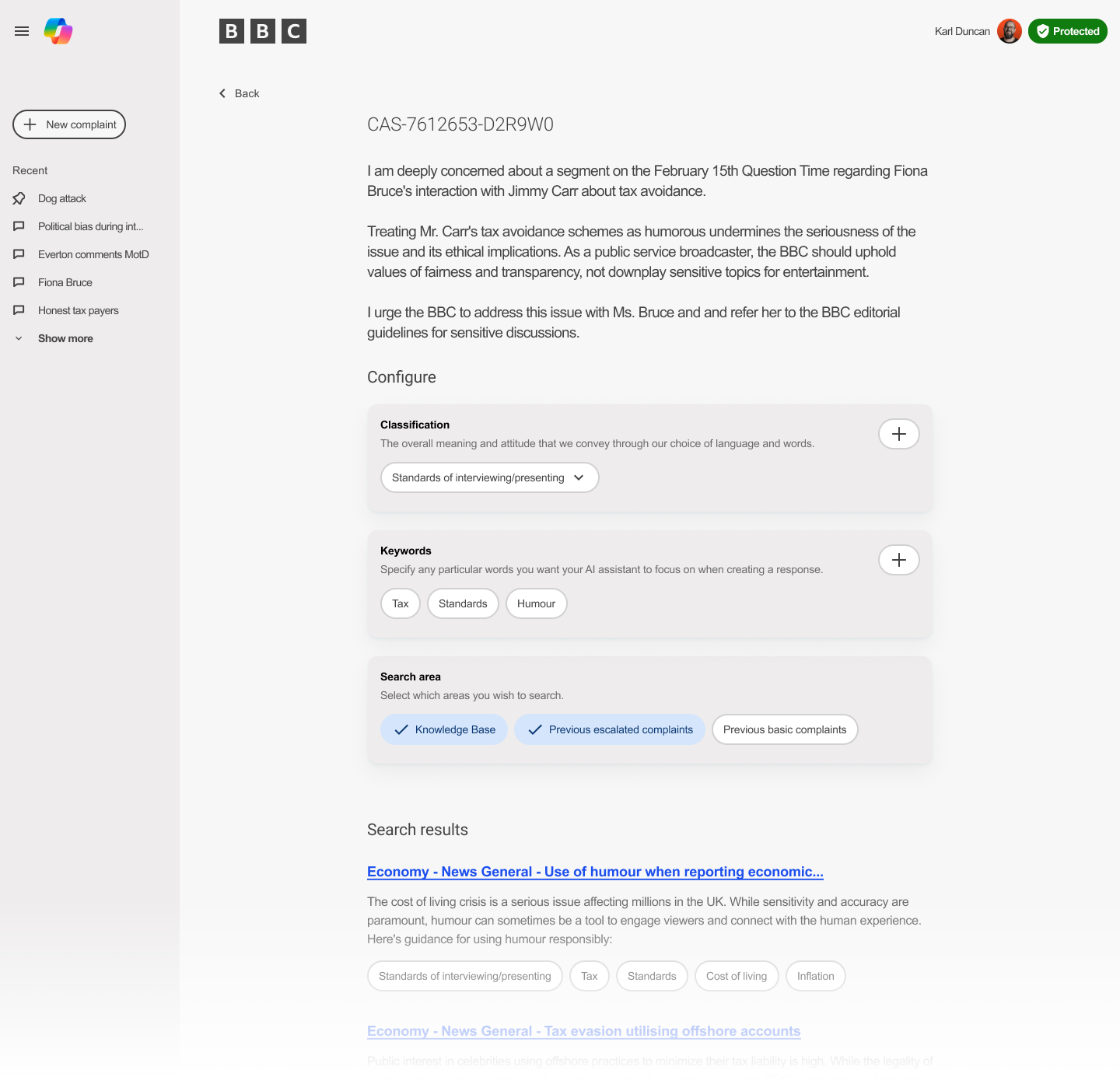
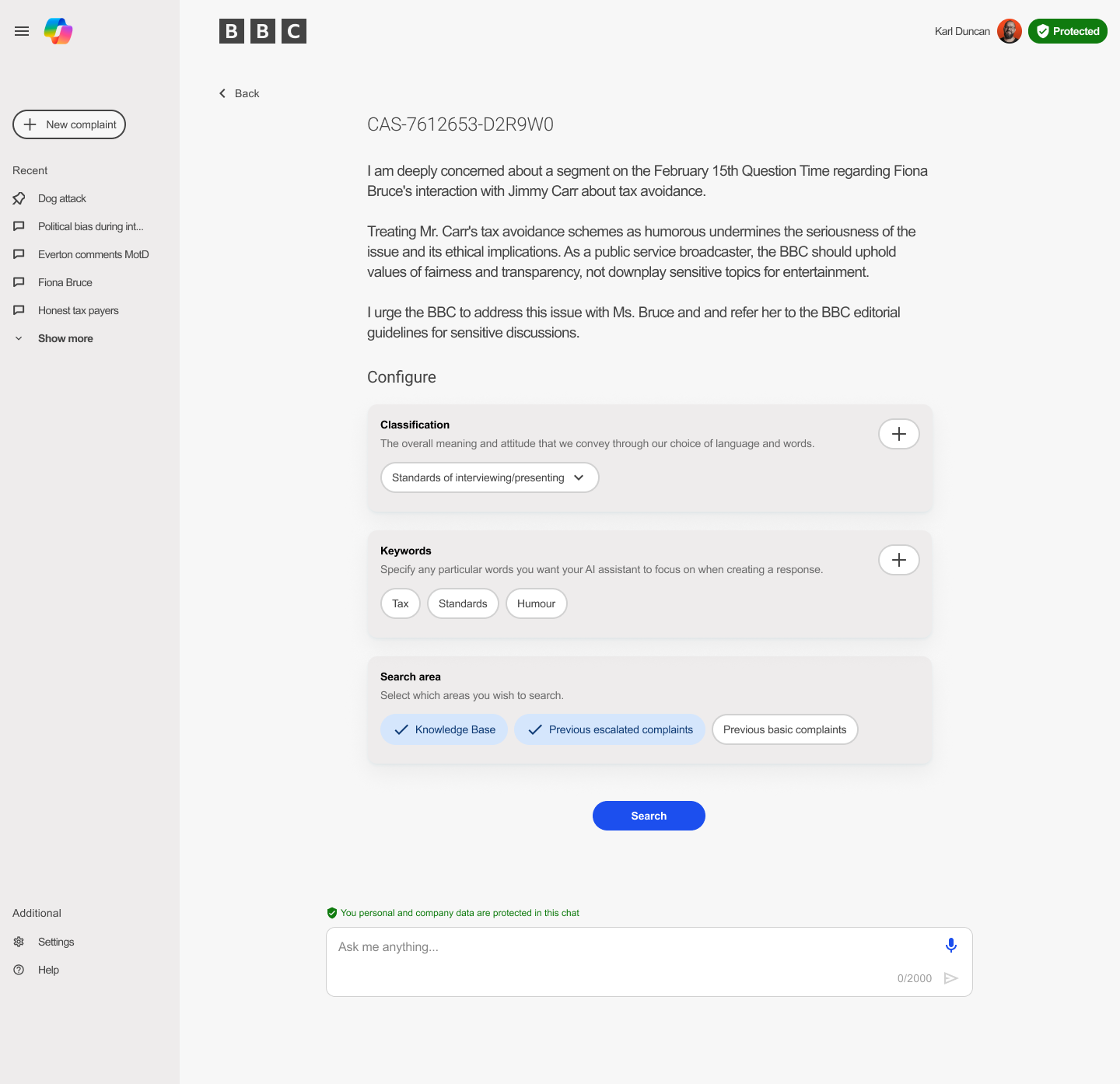
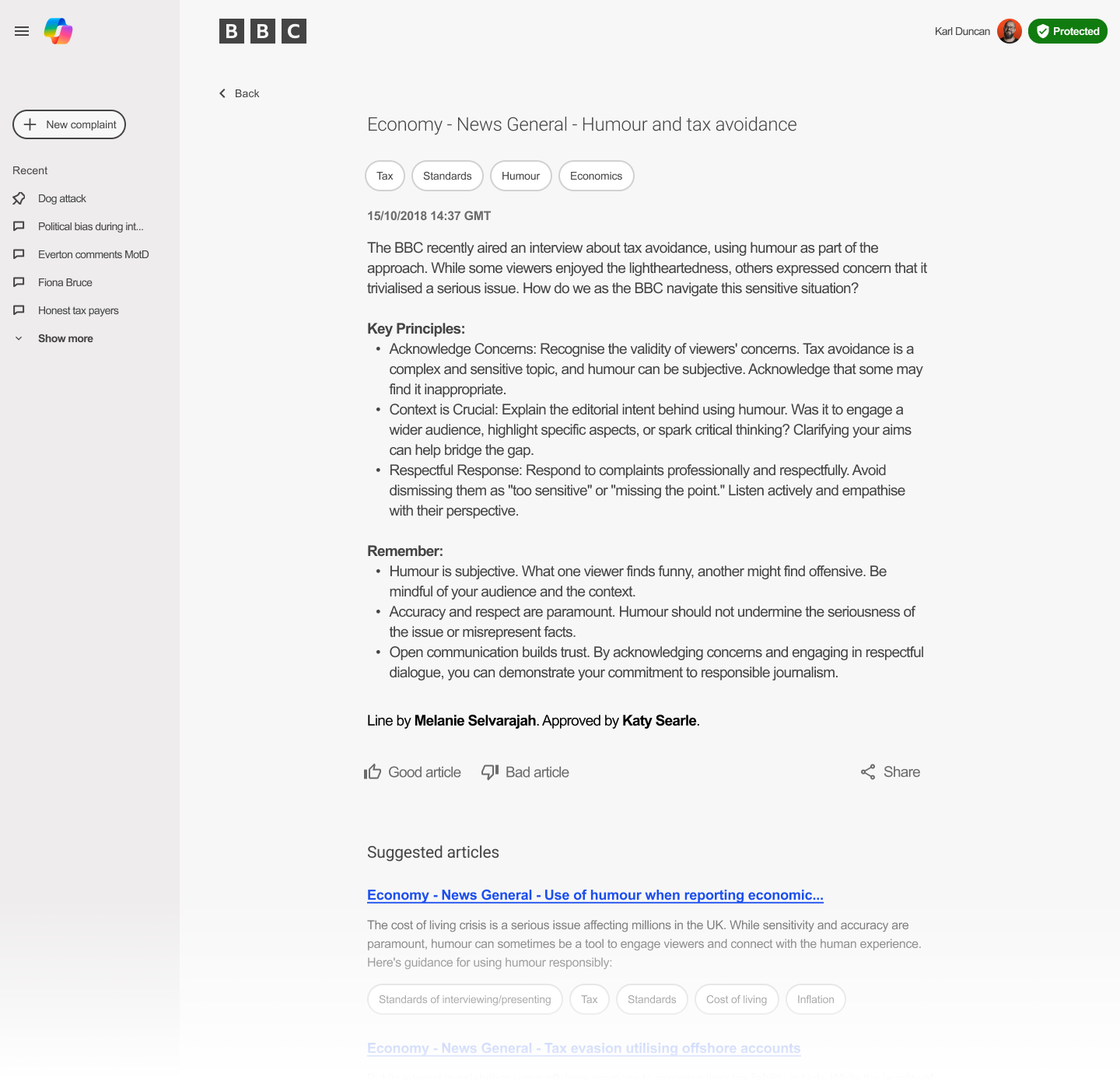
High-fidelity screen concepts were developed to showcase the potential of GenAI integration. These concepts, presented during the discovery findings, received positive feedback, emphasising their conceptual nature rather than a final design.
Generate a response to a complaint
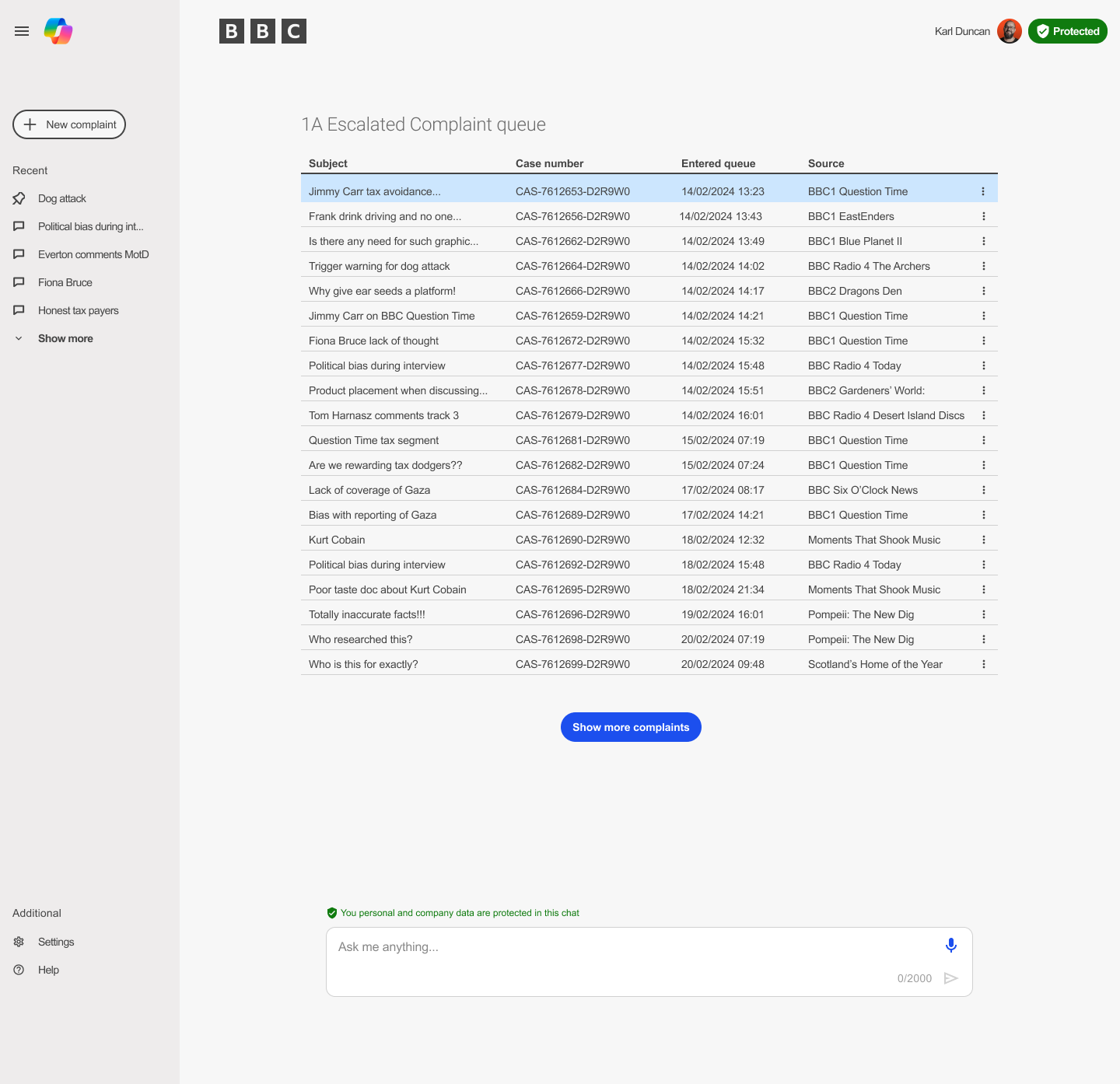

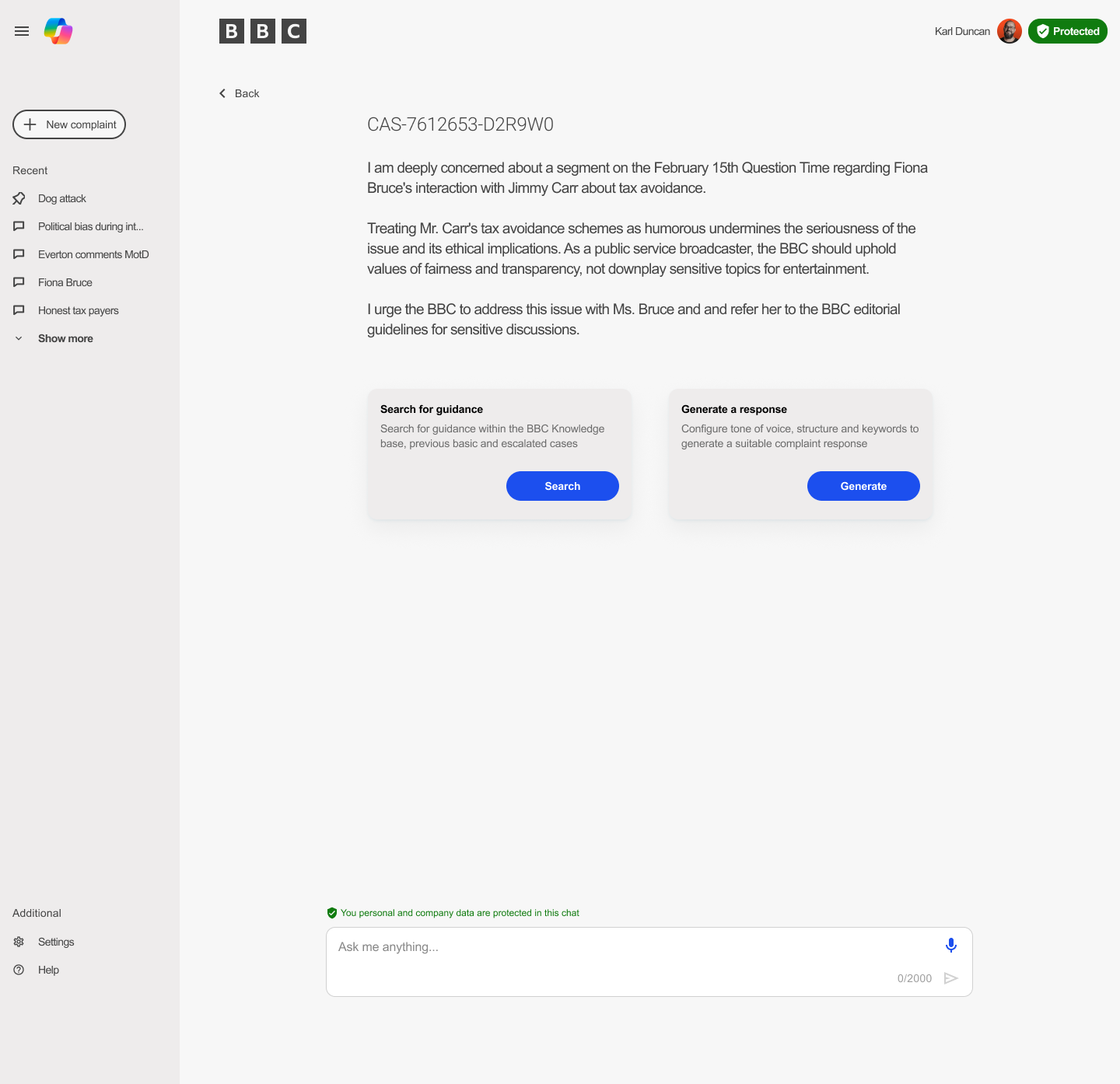
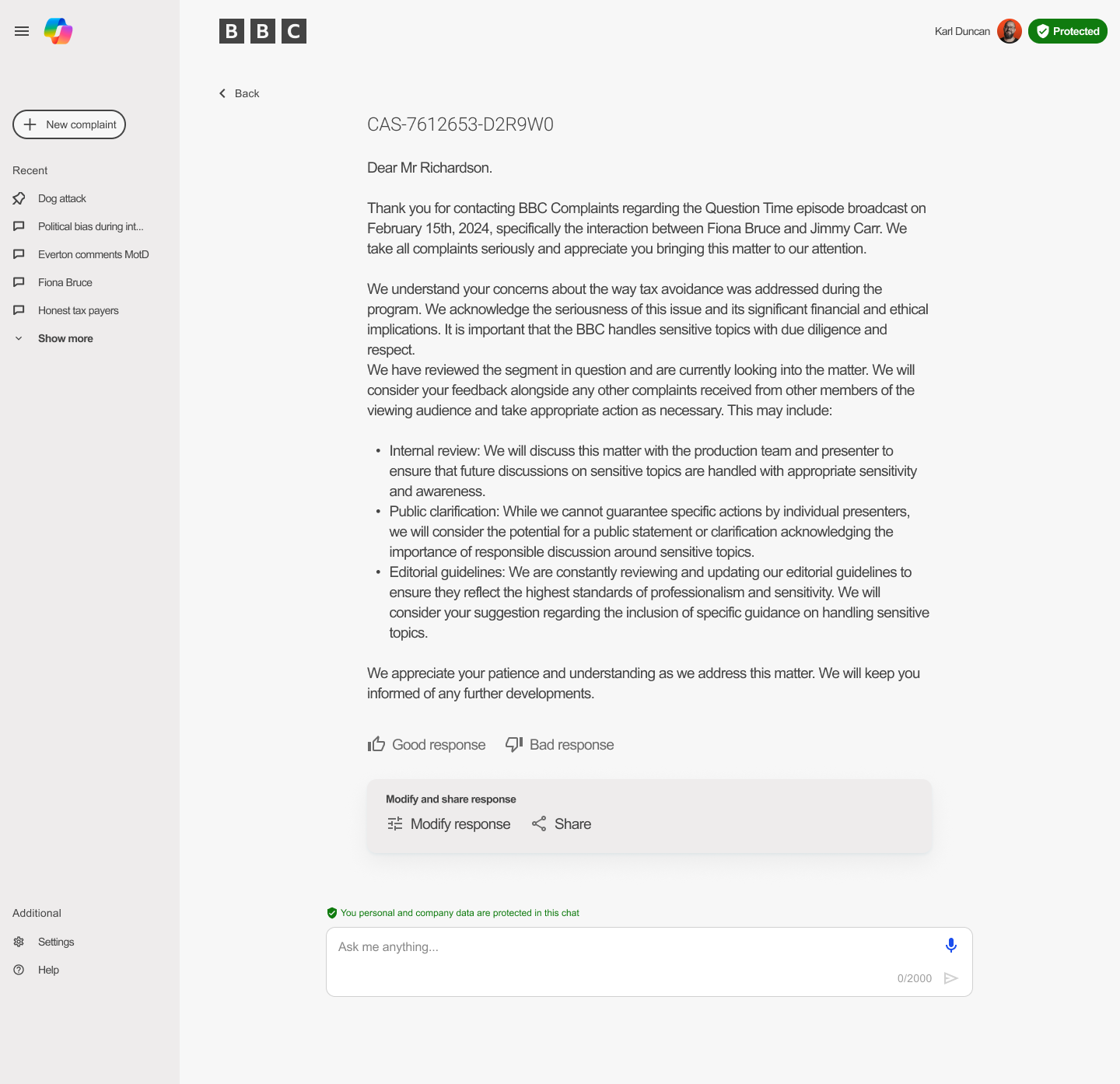
Request guidance via KB and previous cases
Key insights from 1 month discovery phase
Stakeholder Alignment and User Education: Negative media portrayals of Artificial Intelligence (AI) can create apprehension amongst users. To mitigate this, we prefaced each meeting with a clear and concise explanation of Generative AI in layman's terms. We emphasised its potential to improve user efficiency, particularly in knowledge base (KB) searches. We also stressed that Generative AI is a tool meant to enhance user workflows, not a complete automation that would replace human oversight. This approach fostered positive SME and user engagement and ensured their receptiveness to taking part in our discovery and our proposed solutions.
Importance of Proactive Planning: The success of our user research (UR) interviews hinged on our ability to secure meetings with SMEs and access to users within a tight one-week sprint timeframe. Limited availability due to annual leave or other commitments could have significantly hampered our research efforts. This experience highlights the limitation of one-week sprints and importance of proactive planning and scheduling for future projects.
I was nominated by my peers and line manager for a Q1 award within Capita for “Succeeding in delighting our clients and their customers”. It's always nice to be recognised for the work that you do!
Next steps
Q2 will mark the start of the Proof of Concept (PoC) stage, where the team will collaborate with Capita’s technical partners Microsoft.
